
AI is no longer optional.
Most companies already use it in some form. The numbers prove it. Adoption has jumped from 55% in 2023 to 78% today. Even more interesting, 88% of companies use AI in at least one function. (Source)
But here’s the catch.
Only about 5% to 33% move beyond small pilots. (Source)
So what’s going wrong? Not technology. Not tools. But preparation.
We have seen this play out many times. A team buys AI tools. Runs a pilot. Gets decent results. Then things slow down. Interest fades. The project stalls.
The problem is simple. They skipped AI readiness.
Think of AI like a high-performance car. If your roads are broken, the car won’t help. It might even crash.
This is where a strong enterprise AI strategy begins. Not with tools. With readiness.
What Does AI Readiness Really Mean?
AI readiness means your organization is set up to use AI properly. Not test it. Not admire it. Use it.
And that depends on three things = people, process, technology.
Miss one, and everything slows down.
A lot of teams confuse experimentation with readiness. They build a chatbot. Or a dashboard. Or a small model.
It works. For a while.
But scaling? That’s where things break. Because scaling needs structure.
The good news? You don’t need a massive overhaul. You need clarity. And the right sequence.
Data Readiness: The Foundation of Every AI Initiative
Let’s start with the most important piece. Data.
No data, no AI. Bad data, bad AI.
It’s that simple!
Why Data Quality Matters
Imagine asking AI to predict next quarter’s sales.
But your CRM has gaps. Some entries are missing. Others are duplicated. Dates don’t match.
Now ask yourself. Would you trust the output? Probably not.
AI does not fix bad data. It amplifies it.
Good data, on the other hand, gives you:
- Reliable predictions
- Better insights
- Faster decisions
Building Strong Data Governance
Now comes the part most teams ignore. Data governance.
It sounds technical. It’s not.
It simply answers three questions.
- Who owns the data?
- Who can access it?
- How is it maintained?
Without this, confusion spreads fast.
Different teams define the same metric differently. Reports don’t match. Trust drops.
With governance, things change.
Data becomes consistent. Teams align. AI models improve.
A Simple Reality Check
Pause for a second. Ask yourself:
- Is your data scattered across tools?
- Do you check data quality regularly?
- Do people trust your reports?
If the answer is “not really”… start here.
Infrastructure and Integration Readiness
Now let’s talk about systems. Because even perfect data fails on weak infrastructure.
The Infrastructure Problem
AI needs speed. Storage. Scale.
Old systems struggle with this.
Picture this. A retail company runs demand forecasting. Data spikes during peak season. Systems slow down. Predictions arrive late.
Late insights are useless.
Modern infrastructure solves this. Cloud, on-premise, or hybrid setups. The choice depends on your needs. The goal stays the same = scalability.
Integration: The Hidden Bottleneck
Here’s where most projects get stuck. Systems don’t talk to each other.
Data sits in silos. Sales in one tool. Operations in another. Finance somewhere else.
AI needs all of it. Together.
Without integration, you get:
- Delays
- Manual work
- Incomplete insights
It’s like trying to cook with ingredients locked in different rooms.
You need a connection. APIs. Pipelines. Clean data flow.
Building for What’s Next
An AI-ready system is not rigid. It adapts.
You want:
- Real-time data flow
- Easy integrations
- Flexibility for new use cases
This is where an AI implementation roadmap helps. It gives direction.
What to fix first? What to build next? How to scale?
Without it, teams guess. And guesswork slows everything down.
Security and Compliance Considerations
Now let’s talk about risk. Because AI deals with sensitive data. And mistakes here are expensive.
Security Basics That Matter
Start with the basics.
Encrypt your data. Control access. Monitor usage.
Sounds obvious. Often ignored.
A finance company running fraud detection cannot afford a data leak. A healthcare system cannot risk patient data exposure.
Security is not an add-on. It’s a base layer.
Compliance Is Not Optional
Different industries follow different rules.
GDPR. CCPA. PCI DSS. HIPAA. Others.
But beyond rules, there’s trust.
If your AI system shows bias or mishandles data, people lose confidence.
And once trust drops, adoption drops.
Managing AI Risks
AI introduces new challenges. Models make decisions. Sometimes wrong ones.
You need:
- Clear validation processes
- Audit trails
- Defined accountability
Ask yourself one thing. If your AI makes a bad decision tomorrow, do you know how to trace it? If not, fix that.
Aligning AI with Business Objectives
This is where things either click… or collapse.
The Most Common Mistake
Teams start with AI. They should start with the problem.
We have seen companies that built a chatbot. It worked well. Fast responses. Clean interface.
No one used it. Why? It solved nothing important.
Start With Outcomes
Always ask: What are we trying to improve?
Examples:
- Reduce churn
- Improve forecasting
- Speed up support
Now AI has a role. Without this, AI becomes a side project.
Alignment Across Teams
AI is not just IT.
It needs:
- Leadership direction
- Business input
- Technical execution
A clear enterprise AI strategy keeps everyone aligned.
Without alignment, even good models fail.
Talent, Skills, and Organizational Readiness
Let’s talk about people. Because tools don’t run themselves.
You need:
- Data skills
- AI understanding
- Decision-making confidence
But here’s the thing. You don’t need a huge team. You simply need the right mix.
Upskill your current team. Bring in experts where needed. Build a culture where data drives decisions.
We have seen teams with average tools outperform teams with the best tools.
Why? Better adoption.
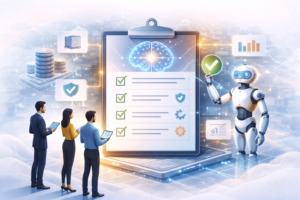
AI Readiness Checklist
If we had to summarize everything into a quick check, it would look like this:
- Is your data reliable and governed?
- Can your systems scale and integrate?
- Are security and compliance handled?
- Do your AI efforts tie to business goals?
- Do your teams have the right skills?
- Do you have a clear AI implementation roadmap?
If you answered “no” to a few, that’s your starting point.
From Readiness to Real Impact
AI does not fail because of technology. It fails because of weak foundations.
Companies that invest in AI readiness move faster. Scale better. See real returns.
Others stay stuck in pilot mode.
The difference is not effort. It’s preparation.
Build AI Readiness with CyberMeru’s IT Transformation Expertise
Here’s the honest truth.
AI readiness does not happen on its own. It depends on your IT foundation.
If your systems are slow, fragmented, or outdated, AI will struggle.
This is where CyberMeru steps in.
Why IT Transformation Matters
IT transformation reshapes how your systems work.
It improves:
- Infrastructure
- Applications
- Data management
- Service delivery
The goal is simple. Make IT proactive. Not reactive.
So your business responds faster. Adapts faster. Decides faster.
What This Means for You
A strong IT foundation leads to:
- Smooth AI deployment
- Better data flow
- Lower operational risk
- Faster innovation
It also reduces costs. Many organizations see 20% to 40% savings.
How CyberMeru Helps
CyberMeru focuses on practical outcomes.
We help you:
- Improve IT agility
- Align IT with business goals
- Deliver faster results
Our services cover:
- IT operating models
- Governance and management
- Service and solution delivery
- Workforce transformation
IT Optimization That Works
Our approach is structured.
We study your current IT setup. Identify gaps. Build a clear plan. Then execute.
The result? Better performance. Lower costs. Stronger systems.
We also offer a shared savings model. So success is measurable.
Ready to Move Forward?
If your AI journey feels stuck, don’t add more tools.
Fix the foundation.
CyberMeru helps you reduce IT costs, improve performance, and build a strong enterprise AI strategy.
Contact CyberMeru and take the next step toward becoming AI-ready!
FAQs
- What does AI readiness actually mean?
It means you’re set up to use AI in real work, not just test it. - Why do AI projects get stuck after pilots?
Because data is messy, systems don’t connect, or goals aren’t clear. - Do I really need data governance?
Yes. Without it, your data gets inconsistent, and AI results become unreliable. - Can I start AI without big changes?
Yes. Start small, fix key gaps, and follow a clear roadmap. - How can CyberMeru help here?
We fix your IT foundation so your AI efforts run smoothly and scale faster!

