
Why Oracle Fusion Adoption Is Accelerating Across Enterprises

Enterprises face a fast world. Old software slows them down. Today, Oracle Fusion adoption is rising fast. Oracle reported strong numbers for Q1 2026. Their Fusion Cloud ERP revenue grew 17%. Total cloud revenue jumped 44%. These numbers tell a story. Businesses want speed. They want tools prepared for the future. (Source) Modern leaders move […]
Oracle ERP Updates: What Enterprises Need to Know This Quarter

This is not an uncommon situation. In the first year following go-live, the majority of enterprises only utilize 30 to 40 percent of Oracle Fusion’s capabilities. According to a 2026 post-implementation assessment by EPIQ Infotech, with each update cycle that goes unreviewed, substantial value is lost. Oracle is not slowing down. Oracle Fusion Cloud ERP […]
The Next Wave of Automation: From Task Bots to Intelligent Workflows
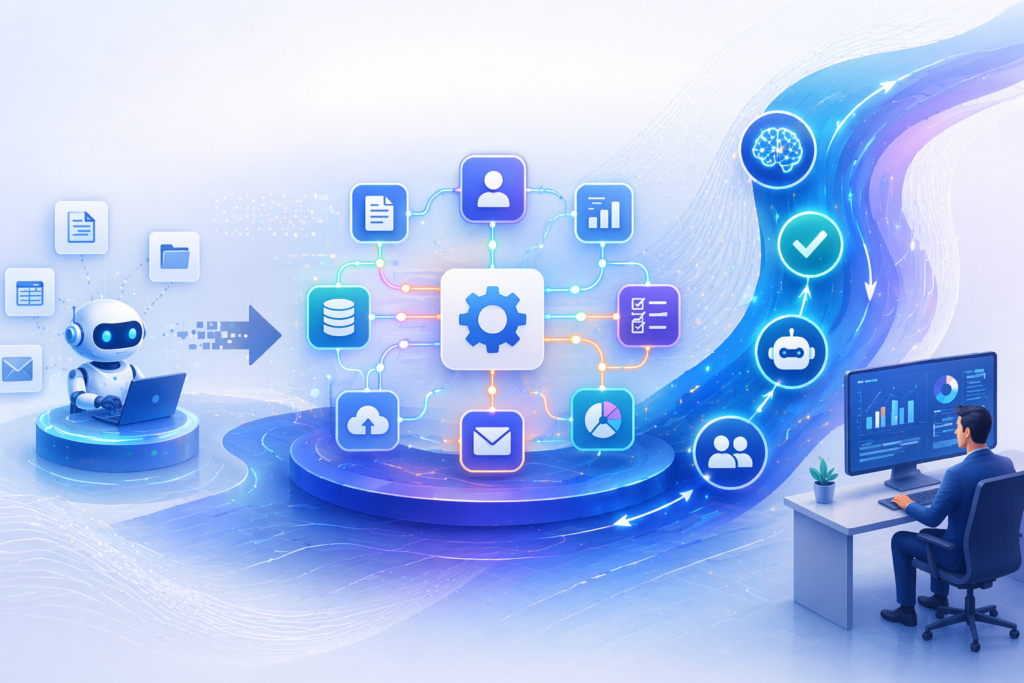
Most enterprises do not struggle because they lack automation tools. They struggle because work still fragments across ERP transactions, approvals, exceptions, and cross team handoffs. That is why intelligent automation is becoming the next serious priority. CyberMeru own recent blog direction already points to this shift through its focus on intelligent workflow design, ERP modernization, […]
AI Readiness Checklist: Is Your Organization Prepared for Intelligent Systems?

AI is no longer optional. Most companies already use it in some form. The numbers prove it. Adoption has jumped from 55% in 2023 to 78% today. Even more interesting, 88% of companies use AI in at least one function. (Source) But here’s the catch. Only about 5% to 33% move beyond small pilots. (Source) […]
Custom Web Applications as ERP Extensions: A Smarter Modernization Path

An ERP system lives at the core of your business. Finance, operations, HR, and supply chains all revolve around ERP. This is where your most important information is kept. However, many ERPs have difficulty adapting to business demands. A Traditional ERP upgrade will require a significant investment in time and capital, and is inherently risky. […]
Intelligent Workflow Design: Where AI, ERP, and Automation Converge

For the past two decades, enterprises have invested heavily in technology – ERP platforms, automation tools, and analytics engines. Each wave promised efficiency. And in many ways, it delivered. Yet inside most organizations, operations still depend heavily on human oversight. Managers check dashboards, teams intervene when processes stall, and approvals pile up because something didn’t […]
Why ERP Data Quality Will Define AI Success in the Coming Years

AI is today at the heart of every key business ambition. Strategy decks reference it. Roadmaps depend on it. Investment conversations assume it. Yet beneath the acceleration sits a constraint many organizations are only beginning to confront with clarity: AI does not struggle because of algorithms. It struggles because of data quality. AI systems are […]
Building ERP Extensions with Custom Web Applications

ERP systems sit at the center of business operations. Finance, sales, procurement, manufacturing, and HR all depend on one system. Over time, teams demand more speed, better interfaces, and workflows aligned with daily work. Standard ERP modules struggle to keep pace with these needs. This gap creates friction. Users rely on spreadsheets. Teams create workarounds. […]
Oracle ERP Trends 2026: What Enterprises Must Prepare for Now

Enterprise systems rarely change overnight, but the direction they take becomes clear years before results appear. Oracle ERP is entering a phase where intelligence, automation, and simplicity matter more than heavy customization. Organizations that wait for certainty often fall behind competitors who prepare early with steady and informed action and timely Oracle ERP modernization. This […]
From Assistive AI to Agentic Systems: The Next Phase of Digital Transformation

For most enterprises, artificial intelligence has played a supporting role in the past. It has helped people analyze data faster, predict outcomes better, and decide with more confidence. But it has remained largely passive, offering recommendations while humans have retained control over execution. That model made sense when scale was manageable, and decision cycles were […]

